
Table of Contents
- How Do You Pay Yourself as a Small Business Owner?
- Unsure Whether You Should Take a Salary or Owner’s Draw?
- How to Pay Yourself Based on Your Business Structure
- How Much Should You Pay Yourself?
- Taxes on Owner Salary, Draws, and Distributions
- Owner Compensation Mistakes to Avoid
- Owner Salary vs. Draw: Real-World Business Examples
- When Should You Hire an Accountant for Owner Compensation?
- How KP Accounting Helps Small Business Owners Pay Themselves Correctly
- FAQs
- Conclusion: Pay Yourself Correctly Without Putting Your Business at Risk
You started your business to build something valuable, earn a living, and create financial independence.
But once your business starts making money, an important question comes up:
How should you pay yourself as a small-business owner?
Should you transfer money directly from your business account? Put yourself on payroll? Take an owner’s draw? Or pay yourself a salary and additional distributions?
The answer depends on how your business is structured and taxed.
For example, a sole proprietor generally takes owner’s draws rather than receiving W-2 wages from their own sole proprietorship. A partner generally cannot be treated as a W-2 employee of the partnership for federal employment tax purposes. An S corporation shareholder who works in the business generally must receive reasonable compensation for services before taking non-wage distributions.
These distinctions matter because the wrong owner payment method can create bookkeeping errors, payroll tax problems, and potentially costly tax consequences.
At KP Accounting, we help small-business owners with bookkeeping, payroll, financial reporting, and tax planning so they can better understand how business transactions affect their finances.
In this guide, you’ll learn how to pay yourself as a business owner, the difference between an owner’s salary and draw, how LLC and S corporation owner compensation works, and how to choose a sustainable payment amount.
Whether you’re starting an LLC, operating an established business, or considering an S corporation tax election, this guide will help you understand the key decisions.
How Do You Pay Yourself as a Small Business Owner?
How you pay yourself depends on your business’s federal tax classification:
- Sole proprietorship: Generally take an owner’s draw, not a W-2 salary.
- Single-member LLC taxed as a sole proprietorship: Generally take an owner’s draw.
- Multi-member LLC taxed as a partnership: Owners generally receive distributions or guaranteed payments, not W-2 wages for their services as partners.
- S corporation: Working shareholder-officers generally must receive reasonable W-2 compensation for services before taking non-wage distributions.
- C corporation: Owners who work as employees may receive W-2 wages and may also receive dividends, subject to applicable rules.
The most important rule: An LLC is a legal business structure, but its federal tax classification determines much of the appropriate owner compensation treatment.
A single-member LLC, partnership-taxed LLC, and LLC taxed as an S corporation do not necessarily pay their owners in the same way.
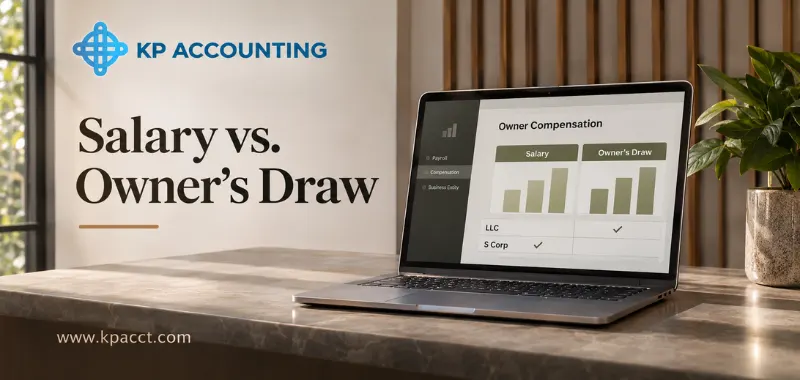
Unsure Whether You Should Take a Salary or Owner’s Draw?
Incorrectly recording owner payments can affect payroll, financial statements, and tax reporting.
KP Accounting helps small-business owners understand their financial records and evaluate owner compensation questions.
Schedule an Owner Compensation Consultation
What Is an Owner’s Draw?
An owner’s draw is money or other property a business owner withdraws from the business for personal use. It generally reduces the owner’s equity rather than being recorded as an operating expense. Owner’s draws are commonly used by sole proprietors and owners of disregarded single-member LLCs.
Example
Suppose you operate a sole proprietorship.
Your business earns $12,000 in monthly revenue and incurs $7,000 in deductible business expenses.
Simplified business profit:
$12,000 − $7,000 = $5,000
You transfer $3,000 from your business checking account to your personal account.
That $3,000 is an owner’s draw.
It is generally not a deductible business expense.
The business’s profit remains $5,000 for this simplified example.
How Is an Owner’s Draw Recorded?
A typical bookkeeping entry is:
Debit: Owner’s Draw – $3,000
Credit: Cash – $3,000
This reduces cash and owner equity.
It does not reduce the business’s operating profit.
Is an Owner’s Draw Taxable?
For a sole proprietor or a disregarded single-member LLC owned by an individual, the owner’s federal income tax generally depends on the business’s taxable income, not simply the amount withdrawn.
A draw generally does not create a second federal income tax merely because cash moves from the business account to the owner’s personal account.
However, partnership and corporate distributions can have different tax consequences, including basis-related rules.
What Is an Owner’s Salary?
An owner’s salary is compensation paid through payroll for services performed as an employee of the business. It generally involves wage reporting, applicable tax withholding, employer payroll taxes, and Form W-2.
Owner salaries are particularly relevant to corporations, including S corporations with shareholder-employees.
Example
Suppose an S corporation pays its working owner:
Annual W-2 salary: $72,000
Monthly gross salary:
$72,000 ÷ 12 = $6,000
The company processes the salary through payroll, withholds applicable employee taxes, and pays employer payroll taxes.
The owner receives net pay after withholding and other applicable deductions.
What Does Payroll Involve?
Depending on the circumstances:
- Federal income tax withholding
- Social Security tax
- Medicare tax
- Employer payroll taxes
- State income tax withholding
- State payroll requirements
- Payroll reporting
- Form W-2 preparation
Important
An owner cannot automatically choose to treat a transfer as a salary simply by labeling it “salary” in the accounting software.
The business’s tax classification and the owner’s employment status determine the proper treatment.
Owner Salary vs. Owner’s Draw: What’s the Difference?
| Feature | Owner’s Draw | Owner’s Salary |
|---|---|---|
| What it is | Withdrawal of business funds or property | Compensation for services |
| Commonly used by | Sole proprietors and disregarded LLC owners | Shareholder-employees of corporations |
| W-2 issued? | Generally no | Generally yes |
| Payroll withholding? | Generally not on the draw itself | Applicable payroll withholding |
| Deductible business expense? | Generally no | Qualifying reasonable wages generally are |
| Reduces business cash? | Yes | Yes |
| Reduces P&L profit? | Generally no | Generally yes |
| Tax treatment | Depends on entity and owner-level rules | Generally treated as wage income |
| Bookkeeping classification | Equity or distribution account | Payroll expense and related liabilities |
Which Is Better: Salary or Draw?
Neither method is universally better.
The correct approach depends primarily on the business’s tax classification.
For example:
- A sole proprietor generally should not put themselves on W-2 payroll as an employee of their sole proprietorship.
- An S corporation shareholder performing substantial services generally cannot replace all reasonable wages with distributions.
- A partner generally cannot choose ordinary employee wages for services performed as a partner.
The correct payment method comes before any discussion of potential tax savings.
How to Pay Yourself Based on Your Business Structure
How to Pay Yourself as a Sole Proprietor
Sole proprietors generally pay themselves through owner’s draws. They transfer funds from the business to their personal accounts and record the withdrawal as equity rather than a deductible business expense.
Step-by-Step Process
Step 1: Calculate available business cash.
Review your current bank balance, upcoming expenses, and tax obligations.
Step 2: Estimate business profit.
Review your Profit and Loss Statement.
Step 3: Set aside money for taxes and business needs.
Consider estimated taxes, operating expenses, and emergency reserves.
Step 4: Transfer the desired amount.
Move funds to your personal account.
Step 5: Record the transfer correctly.
Classify it as an owner’s draw.
Example
Monthly business revenue: $15,000
Monthly deductible expenses: $8,000
Simplified monthly profit: $7,000
Owner’s draw: $4,000
Remaining cash from these simplified monthly operations: $3,000
This does not account for beginning cash, capital spending, debt repayments, or other cash movements.
Tax Considerations
A sole proprietor generally reports business income and expenses on Schedule C attached to Form 1040.
Net earnings from self-employment may also be subject to self-employment tax, subject to applicable rules.
Taking a smaller draw does not automatically reduce taxable business profit.
How to Pay Yourself From a Single-Member LLC
If your single-member LLC is taxed as a disregarded entity and you are its individual owner, you generally pay yourself through owner’s draws rather than W-2 wages. If the LLC has elected corporate tax treatment, different rules apply.
Why LLC Tax Classification Matters
An LLC is formed under state law.
For federal tax purposes, it may be classified as:
- A disregarded entity
- A partnership
- A C corporation
- An S corporation, if eligible and properly elected
A single-member LLC does not automatically become an S corporation.
Example: Paying Yourself From a Disregarded LLC
Business revenue: $25,000 per month
Business expenses: $16,000 per month
Simplified profit: $9,000
Owner withdraws: $5,000
The $5,000 is generally recorded as an owner’s draw.
It is not automatically a deductible payroll expense.
How Often Can You Take an LLC Owner’s Draw?
There is generally no universal federal requirement that an owner of a disregarded LLC withdraw funds on a particular schedule.
You might choose:
- Weekly transfers
- Biweekly transfers
- Monthly transfers
- Periodic transfers based on cash availability
However, a consistent schedule can make personal budgeting and business cash-flow planning easier.
Can an LLC Owner Put Themselves on Payroll?
It depends on the LLC’s tax classification.
An individual owner of a disregarded single-member LLC generally is not treated as an employee of that LLC for federal employment tax purposes with respect to their own services.
If the LLC is taxed as an S corporation or C corporation, the owner may be an employee and payroll requirements may apply.
How to Pay Yourself From a Multi-Member LLC
A multi-member LLC taxed as a partnership generally compensates its members through distributions and, where applicable, guaranteed payments. Members are generally treated as partners rather than employees for federal employment tax purposes.
What Is a Partnership Distribution?
A distribution is a transfer of cash or property from the partnership to a partner.
It is generally not treated as a deductible operating expense.
Its tax consequences can depend on the partner’s basis and other partnership rules.
What Is a Guaranteed Payment?
A guaranteed payment is a payment to a partner determined without regard to partnership income, commonly for services or the use of capital.
Example
A two-member LLC is taxed as a partnership.
Partner A actively manages operations.
Partner B primarily contributes capital.
Under the partnership agreement, Partner A receives a guaranteed payment for management services.
The partners may also receive distributions according to the agreement and applicable law.
Guaranteed Payments vs. Distributions
| Guaranteed Payment | Partnership Distribution |
|---|---|
| Determined without regard to partnership income | Generally represents a distribution of partnership cash or property |
| May compensate services or capital | Not automatically compensation for services |
| May be deductible or capitalized by the partnership depending on purpose | Generally not deductible by the partnership |
| Generally included in partner income | Tax consequences depend on basis and other rules |
| Service-related payments generally can affect self-employment tax | Self-employment tax treatment depends on the partner and underlying income |
Important
A partner’s self-employment tax exposure is not determined solely by the amount of cash distributed.
Partnership tax allocations, guaranteed payments, and the partner’s status can all matter.
How to Pay Yourself as an S Corporation Owner
An S corporation shareholder who performs services for the business generally must receive reasonable compensation as W-2 wages before taking non-wage distributions. The IRS can reclassify purported distributions as wages when they are actually compensation for services.
This is one of the most important differences between a disregarded LLC and an S corporation.
How S Corporation Owner Compensation Works
An owner may receive:
1. W-2 salary
Compensation for services performed.
2. Shareholder distributions
Non-wage transfers of corporate funds or property, subject to applicable tax and basis rules.
Example
An S corporation generates:
Annual revenue: $350,000
Business expenses before owner compensation: $180,000
Profit before owner compensation: $170,000
Suppose a reasonable annual owner salary is determined to be $85,000 based on the owner’s services and relevant facts.
The corporation pays:
W-2 salary: $85,000
Employer payroll taxes: Additional applicable expense
The remaining business income is determined after all applicable deductions and adjustments.
The owner may also receive distributions if sufficient cash is available and the distributions are otherwise appropriate.
Important
The $85,000 figure is illustrative.
It is not an IRS-approved salary amount or a universal reasonable-compensation benchmark.
A reasonable salary must be determined from the actual facts.
Why Does the IRS Care?
S corporation wages generally are subject to applicable employment taxes.
Non-wage S corporation distributions generally are not subject to employment taxes merely because they are distributions.
The IRS scrutinizes arrangements in which shareholder-employees receive little or no wages while taking substantial distributions for services they perform.
Can You Pay Yourself Only Distributions?
If you perform services for your S corporation, paying yourself exclusively through distributions can create significant payroll tax compliance risk.
The appropriate compensation depends on the services performed and the relevant circumstances.
What Is Reasonable Compensation for an S Corp Owner?
Reasonable compensation is the amount an S corporation would reasonably pay for the services its shareholder-employee performs, considering the facts and circumstances. The IRS does not prescribe a universal salary amount or a fixed percentage of business profit.
Factors That Can Affect Reasonable Compensation
- Duties performed
- Time devoted to the business
- Professional experience
- Specialized skills
- Management responsibilities
- Comparable industry wages
- Geographic labor market
- Business size and complexity
- Nature of the services
- Compensation arrangements
Example: Two S Corporation Owners
Owner A
Operates a consulting business full time, manages clients, delivers services, and handles daily operations.
Owner B
Owns shares but performs no services for the company.
Their compensation obligations may differ substantially.
A shareholder’s ownership percentage alone does not determine a reasonable salary.
Is There a 60/40 Rule for S Corp Salary?
No universal IRS rule requires S corporation owners to divide compensation into 60% salary and 40% distributions.
Likewise, there is no universal rule requiring a fixed $50,000 salary or another arbitrary amount.
What Should You Do Instead?
Document the basis for compensation using relevant information, such as:
- Job responsibilities
- Hours worked
- Comparable compensation
- Business financial information
- Professional judgment
Review compensation when the owner’s duties or business circumstances materially change.
S Corp Salary vs. Distributions: Tax Differences
S corporation shareholder wages generally are subject to applicable payroll taxes. Properly classified non-wage distributions generally are not subject to employment taxes, but S corporation income is generally passed through to shareholders for income-tax purposes whether or not the income is distributed.
Example
Assume an S corporation has:
Profit before owner salary and employer payroll taxes: $160,000
Reasonable owner salary: $80,000
The company must account for the salary and applicable employer payroll taxes before determining remaining business income.
The shareholder may owe federal income tax on wages and their allocated share of S corporation income.
Distributions are not automatically tax-free in every circumstance.
Why Basis Matters
S corporation distributions can be taxable when they exceed applicable stock basis or when other special rules apply.
An S corporation shareholder should maintain accurate basis records.
Important Distinction
Business profit, taxable pass-through income, W-2 wages, and cash distributions are four different concepts.
Confusing them can cause bookkeeping and tax reporting errors.
How to Pay Yourself as a C Corporation Owner
A C corporation owner who performs services as an employee may receive W-2 wages. A shareholder may also receive dividends, subject to corporate law and tax rules. Wages and dividends generally receive different federal tax treatment.
Salary
Reasonable compensation for services may generally be deductible by the corporation, subject to applicable limitations.
Dividends
Dividends generally are not deductible by a C corporation.
They may also create shareholder-level income tax consequences.
Example
A C corporation owner works as the company’s president.
The company pays a reasonable W-2 salary for those services.
The corporation may separately declare a dividend to shareholders.
These payments must be classified and reported according to their actual character.
Important
Excessive compensation, disguised dividends, shareholder loans, and other related-party transactions can raise tax issues.
Proper documentation is essential.
How Much Should You Pay Yourself?
How to Determine a Sustainable Owner Payment
To determine how much you can afford to pay yourself, review business profitability, available cash, upcoming expenses, tax obligations, debt payments, and working-capital needs. If your business is taxed as a corporation, also consider applicable reasonable-compensation and payroll requirements.
Step 1: Review Business Revenue
Determine how much revenue the business generates.
Step 2: Calculate Operating Expenses
Include payroll, rent, utilities, inventory-related costs, marketing, insurance, and other obligations.
Step 3: Review Cash Flow
Profit does not equal cash available for withdrawal.
Step 4: Set Aside Tax Reserves
Consider estimated income taxes, payroll taxes, and other obligations.
Step 5: Review Upcoming Payments
Include debt repayments, inventory purchases, and planned capital expenditures.
Step 6: Establish a Cash Reserve
Consider how much cash the business needs to handle seasonal changes and unexpected costs.
Step 7: Determine an Appropriate Payment
Choose a payment amount that is both financially sustainable and consistent with the business’s legal and tax structure.
Example: Owner’s Draw Planning
A disregarded single-member LLC has:
| Category | Monthly Amount |
|---|---|
| Cash received | $30,000 |
| Operating cash payments | ($18,000) |
| Loan principal payments | ($2,000) |
| Planned tax reserve contribution | ($3,000) |
| Cash reserve contribution | ($2,000) |
| Illustrative remaining cash | $5,000 |
The owner might consider a draw of up to $5,000 under these simplified assumptions.
However, the appropriate amount also depends on beginning cash, future obligations, seasonal needs, and the owner’s tax situation.
Never assume that the entire bank balance is available for personal use.
How Often Should a Business Owner Pay Themselves?
There is no universal payment frequency that works for every owner.
A sole proprietor or disregarded LLC owner may choose regular draws, while corporate shareholder-employees should follow an appropriate payroll schedule and applicable wage-payment laws.
Common Payment Schedules
| Frequency | Potential Benefit |
|---|---|
| Weekly | Regular personal cash flow |
| Biweekly | Consistent budgeting |
| Twice monthly | Predictable monthly planning |
| Monthly | Simpler draw scheduling |
| Periodic distributions | Flexibility when business cash varies |
Recommendation
For owners using draws, consider setting a predictable transfer amount based on conservative cash-flow projections.
For shareholder-employees, establish a compliant payroll schedule and review compensation periodically.
Should You Pay Yourself When Your Business Is Losing Money?
Whether you should withdraw money from a loss-making business depends on available cash, essential obligations, financing arrangements, and your business structure. A corporation’s obligations to compensate working employees must also be considered.
Example
Your business reports a monthly loss of $4,000.
The bank account contains $35,000.
But upcoming obligations include:
Payroll: $15,000
Rent: $5,000
Suppliers: $10,000
Only $5,000 remains before considering taxes, debt payments, and other needs.
Taking a large personal withdrawal could create a cash shortage.
Questions to Ask
- Can the business meet payroll?
- Are taxes current?
- Are suppliers being paid?
- Is the loss temporary?
- Are customer payments expected?
- Does the business have enough working capital?
An owner draw should not be based solely on personal spending needs.
How to Record Owner Payments in Bookkeeping
Accurate bookkeeping is essential because different owner payments affect financial statements differently.
Owner’s Draw
Debit: Owner’s Draw
Credit: Cash
Corporate Salary
Payroll accounting generally records:
- Gross wage expense
- Employer payroll tax expense
- Employee withholding liabilities
- Net payroll payments
- Employer tax liabilities and payments
Partnership Guaranteed Payment
A guaranteed payment must be recorded and reported according to its purpose and applicable partnership accounting and tax rules.
Shareholder Distribution
A corporate distribution generally reduces cash and an appropriate equity or distribution account, subject to the entity’s accounting circumstances.
Common Bookkeeping Mistakes
- Recording owner draws as payroll
- Recording shareholder distributions as wages
- Treating loan proceeds as income
- Classifying personal expenses as business deductions
- Failing to reconcile payroll liabilities
- Misclassifying guaranteed payments
- Ignoring shareholder or partner basis records
Why This Matters
An incorrect owner payment entry can distort profitability, tax information, and the business’s financial position.
Taxes on Owner Salary, Draws, and Distributions
Do You Pay Taxes on an Owner’s Draw?
A sole proprietor generally pays federal income tax on taxable business profit, regardless of how much cash is withdrawn. Self-employment tax may also apply. The draw itself generally does not create a second income-tax event.
Example
Annual business profit: $90,000
Annual owner’s draws: $55,000
The owner’s federal tax calculation generally starts with the business’s taxable income and applicable adjustments – not simply the $55,000 withdrawn.
Important
The treatment of partnership distributions and corporate distributions differs from sole proprietor draws.
Do not apply the same rule to every business structure.
Do LLC Owners Pay Self-Employment Tax?
Owners of disregarded single-member LLCs generally are subject to self-employment tax on qualifying net earnings from the business, subject to applicable rules. Members of partnership-taxed LLCs may also be subject to self-employment tax, depending on their circumstances.
An LLC’s legal status alone does not eliminate self-employment tax.
What Does Self-Employment Tax Cover?
Self-employment tax generally supports:
- Social Security
- Medicare
The commonly cited combined rate is 15.3% before considering the Social Security wage base, additional Medicare tax rules, and other applicable calculations.
The effective amount depends on the taxpayer’s circumstances.
Important
An S corporation shareholder’s properly classified pass-through income generally is not self-employment income merely because the shareholder owns the business.
However, shareholder-employee wages generally are subject to applicable employment taxes.
Can an S Corp Help Reduce Self-Employment Taxes?
An S corporation election may change the employment tax treatment of owner compensation. However, working shareholder-employees generally must receive reasonable wages, and any potential tax benefit must be weighed against payroll costs, additional filings, state taxes, and other compliance requirements.
Potential Additional Costs
- Payroll processing
- Payroll tax filings
- S corporation income-tax returns
- Additional bookkeeping
- Shareholder basis tracking
- State entity-level taxes
- Professional compliance costs
Important
An S corporation election does not automatically produce tax savings.
The decision should consider business profitability, owner duties, cash flow, state requirements, and total administrative costs.
Can You Change From Owner’s Draw to Salary?
Yes, in some circumstances – but the change may require a change in federal tax classification or business structure.
Example
A single-member LLC currently taxed as a disregarded entity pays its owner through draws.
The owner considers electing S corporation treatment.
If eligible and the election becomes effective, the business may need to:
- Establish owner payroll
- Determine reasonable compensation
- Process payroll taxes
- File applicable payroll returns
- Maintain shareholder distribution records
- Prepare an S corporation return
- Track shareholder basis
Important
An S corporation election has eligibility requirements and filing deadlines.
Do not simply begin labeling draws as salary without reviewing the entity’s tax status.
Owner Compensation Mistakes to Avoid
Ten Common Mistakes Small Business Owners Make
Mistake 1: Paying Yourself Without Knowing Your Tax Classification
A legal LLC structure does not determine every federal tax treatment.
Mistake 2: Treating Owner’s Draws as Deductible Expenses
Draws generally do not reduce operating profit.
Mistake 3: Paying an S Corp Owner Only Distributions
Working shareholder-employees generally must receive reasonable compensation for services.
Mistake 4: Assuming a Fixed Salary Percentage Is IRS-Approved
There is no universal IRS 60/40 salary-distribution rule.
Mistake 5: Ignoring Payroll Taxes
Corporate owner wages generally trigger applicable payroll obligations.
Mistake 6: Withdrawing Too Much Cash
Large owner withdrawals can leave insufficient funds for payroll, taxes, and suppliers.
Mistake 7: Mixing Personal and Business Expenses
This creates bookkeeping and tax reporting problems.
Mistake 8: Misclassifying Partnership Payments
Guaranteed payments and distributions have different tax characteristics.
Mistake 9: Ignoring Shareholder Basis
S corporation distribution tax treatment can depend on basis and other rules.
Mistake 10: Failing to Review Compensation as the Business Grows
Owner duties, profitability, and compensation needs may change.
Owner Salary vs. Draw: Real-World Business Examples
Example 1: Freelance Consultant With a Single-Member LLC
A freelance consultant earns:
Annual revenue: $120,000
Deductible business expenses: $35,000
Simplified business profit: $85,000
The LLC is taxed as a disregarded entity.
The owner withdraws $4,000 per month.
Annual draws:
$48,000
The owner generally reports taxable business profit according to the applicable tax rules, not simply the $48,000 withdrawn.
The draws are not W-2 wages.
Example 2: Two-Member LLC Taxed as a Partnership
Two owners operate a marketing agency.
One owner manages daily operations.
The other primarily handles business development.
The partnership agreement provides for a guaranteed payment to the managing partner and distributions according to the owners’ agreed interests.
The payments must be recorded and reported according to partnership rules.
The owners generally are not W-2 employees for services performed as partners.
Example 3: S Corporation Owner
An S corporation owner works full time managing a professional service business.
The business generates sufficient income to support wages and distributions.
The company determines reasonable compensation based on the owner’s responsibilities and relevant market information.
It processes the owner’s wages through payroll.
Additional shareholder distributions are recorded separately, with appropriate attention to cash availability and basis.
Key Lesson
The owner should not simply choose the lowest possible salary to reduce payroll taxes.
Example 4: Retail Business Owner
A retail business owner operates a sole proprietorship.
The business has strong holiday sales but weaker revenue during other months.
Instead of withdrawing all holiday-season cash, the owner establishes a conservative monthly draw and reserves funds for inventory, rent, and slower periods.
This can improve financial stability.
When Should You Hire an Accountant for Owner Compensation?
Signs You Need Professional Guidance
Consider professional accounting support when you are unsure whether to use payroll or draws, plan to elect S corporation status, need reasonable-compensation analysis, have multiple owners, or struggle to record owner payments correctly.
Professional guidance may be particularly valuable when:
- You recently formed an LLC.
- Your business profits have increased.
- You are considering S corporation taxation.
- You are hiring your first employees.
- You have multiple partners.
- You are uncertain about guaranteed payments.
- Your payroll reports are inconsistent.
- Your business and personal transactions are mixed.
- You are unsure how much cash you can withdraw.
- You need tax planning before year-end.
Why It Matters
Owner compensation decisions can affect:
Payroll compliance
Tax reporting
Cash flow
Financial statements
Business equity
Future financial planning
Getting the classification right from the beginning can reduce avoidable complications.
How KP Accounting Helps Small Business Owners Pay Themselves Correctly
Choosing between an owner’s draw, salary, or distribution is not simply a matter of preference.
It requires understanding your business structure, financial records, and applicable tax rules.
At KP Accounting, we support small-business owners through professional accounting services designed to improve financial organization and visibility.
Bookkeeping Services
Our bookkeeping services help businesses accurately record owner withdrawals, payroll transactions, expenses, and other financial activity.
Payroll Services
Our payroll services support businesses with employee compensation, payroll records, and related payroll processing requirements.
Tax Planning
Tax planning helps business owners evaluate how compensation, business structure, and financial decisions may affect tax obligations.
Financial Reporting
Reliable financial reports help business owners understand profitability, cash availability, liabilities, and financial performance.
Budget Analysis
Budget analysis can help determine whether planned owner payments align with business cash-flow needs and operating commitments.
Tax Return Preparation
Organized owner compensation and accounting records help support accurate tax return preparation.
Supporting Small Businesses in New Jersey and Pennsylvania
KP Accounting serves business owners in:
- Somerville, New Jersey
- Allentown, Pennsylvania
- Walnutport, Pennsylvania
We also support businesses across the United States with accounting and financial management needs.
Whether you operate a sole proprietorship, LLC, partnership, or corporation, properly maintained records help you make more informed decisions.
Not Sure How Much to Pay Yourself?
Before transferring money or changing your payroll structure, make sure you understand the accounting and tax consequences.
KP Accounting can help you review your financial records and identify owner compensation questions that require attention.
Schedule an Owner Compensation Consultation
FAQs
1. How do I pay myself as a small business owner?
The method depends on your business’s tax classification. Sole proprietors generally take draws, partners generally receive distributions or guaranteed payments, and working corporate shareholder-employees may receive wages.
2. Is it better to pay yourself a salary or owner’s draw?
Neither is universally better. The appropriate method depends on how your business is taxed and the services you perform.
3. Can I pay myself a salary from my LLC?
Yes, if your LLC is taxed as a corporation and you are appropriately treated as an employee. An individual owner of a disregarded single-member LLC generally does not receive W-2 wages from that LLC for their own services.
4. How do I pay myself from a single-member LLC?
An individual owner of a disregarded single-member LLC generally transfers money as an owner’s draw and records it in an equity account.
5. Can a multi-member LLC pay owners a salary?
A partnership-taxed LLC generally treats members as partners rather than W-2 employees for their services as partners. Guaranteed payments may be appropriate. Corporate-taxed LLCs follow different rules.
6. What is an owner’s draw?
An owner’s draw is a withdrawal of business funds or property for personal use, generally recorded as a reduction in owner equity.
7. Is an owner’s draw a business expense?
Generally no. Owner’s draws ordinarily do not reduce business operating profit.
8. Do I pay taxes on an owner’s draw?
For a sole proprietor, federal income tax generally is based on taxable business profit rather than the amount drawn. Other entity types can have different distribution tax rules.
9. How much should I pay myself from my LLC?
Consider available cash, operating expenses, taxes, debt payments, reserves, and your LLC’s tax classification. There is no universal payment amount.
10. How often can I take an owner’s draw?
Owners of disregarded businesses generally can choose a suitable draw schedule, subject to cash availability, legal restrictions, and financial obligations.
11. Do S corp owners have to take a salary?
Shareholder-officers who perform services generally must receive reasonable compensation as wages before taking non-wage distributions.
12. What is a reasonable S corp owner salary?
It is compensation appropriate for the owner’s actual services, considering duties, experience, time worked, comparable wages, and other relevant facts.
13. Does the IRS require a 60/40 salary split for S corps?
No. There is no universal IRS rule requiring 60% salary and 40% distributions.
14. Can an S corp owner take distributions instead of salary?
Working shareholder-employees generally cannot substitute distributions for reasonable wages for services performed.
15. Are S corp distributions tax-free?
Not always. Tax treatment depends on shareholder basis, corporate history, and other applicable rules.
16. Do LLC owners pay self-employment tax?
Owners of disregarded LLCs and certain partnership-taxed LLC members generally may owe self-employment tax on qualifying earnings. The rules depend on the facts and classification.
17. Does an S corp reduce self-employment tax?
S corporation treatment may change employment tax exposure, but reasonable wages, compliance costs, and other tax consequences must be considered.
18. Can I switch from an owner’s draw to payroll?
Possibly, but the appropriate change may require corporate tax treatment, proper payroll setup, and compliance with applicable requirements.
19. Can I pay myself when my business is not profitable?
It depends on cash availability, obligations, entity structure, and applicable wage requirements. A withdrawal should not jeopardize essential business payments.
20. What happens if I withdraw too much from my business?
Excessive withdrawals can create cash shortages. Partnership and corporate distributions may also create basis-related or other tax consequences.
21. Is a guaranteed payment the same as a salary?
No. Guaranteed payments to partners are generally treated differently from employee W-2 wages.
22. Should I put myself on payroll as a sole proprietor?
A sole proprietor generally does not pay themselves W-2 wages as an employee of their own sole proprietorship.
23. How do I record owner’s draws in QuickBooks?
Use an appropriate owner equity or draw account rather than an ordinary operating expense account. The exact setup depends on the business structure.
24. When should I consider S corp taxation for my LLC?
Consider it when the business has sufficient profitability and the potential benefits justify reasonable compensation requirements, payroll costs, additional filings, and other consequences.
25. How can KP Accounting help with owner compensation?
KP Accounting provides bookkeeping, payroll, tax planning, financial reporting, and related services that can help owners maintain accurate records and evaluate compensation decisions.
Conclusion: Pay Yourself Correctly Without Putting Your Business at Risk
Paying yourself is one of the most important financial decisions you’ll make as a business owner.
The right method depends on your business’s tax classification, your responsibilities, and the company’s financial position.
Remember these essential differences:
- Sole proprietors generally take owner’s draws.
- Disregarded single-member LLC owners generally take draws.
- Partnership-taxed LLC members generally receive distributions or guaranteed payments.
- Working S corporation shareholder-employees generally must receive reasonable wages.
- C corporation shareholder-employees may receive wages and, separately, dividends.
Just as importantly, the amount you withdraw should be financially sustainable.
Understand Your Business Structure → Choose the Correct Payment Method → Review Cash Flow → Maintain Accurate Records → Plan for Taxes
At KP Accounting, we help small-business owners maintain organized accounting records, manage payroll, review financial performance, and prepare for tax obligations.
Ready to Make Better Owner Compensation Decisions?
Whether you’re paying yourself from an LLC, considering an S corporation election, or trying to understand salary versus distributions, organized accounting records are essential.
Contact KP Accounting to Schedule an Owner Compensation Consultation
Disclaimer: This article is for general educational purposes and does not constitute individualized tax, legal, payroll, or financial advice. Owner compensation, employment tax, distribution, and entity-classification rules depend on the specific facts and applicable federal and state law. Consult qualified professionals before making or changing compensation arrangements.