
Table of Contents
- Introduction – Why Choosing the Right Entity Structure Matters
- What Is an LLC?
- What Is an S-Corporation?
- Key Difference: Self-Employment Tax
- When Does an S-Corp Save More Taxes?
- Compliance Differences
- Payroll Requirements for S-Corps
- Cost Comparison: LLC vs S-Corp
- Business Growth Strategy Matters
- Common Mistakes Business Owners Make
- How KP Accounting Helps You Decide
- Estimated Tax Payments Under Each Structure
- People Also Ask
- Conclusion – Which Saves More Taxes?
INTRODUCTION – WHY CHOOSING THE RIGHT ENTITY STRUCTURE MATTERS
One of the most important financial decisions a business owner makes is choosing between:
- An LLC (Limited Liability Company)
- An S-Corporation (S-Corp)
Most business owners ask:
“Which one saves more in taxes?”
The real answer is:
It depends on your income level, payroll structure, state (NJ or PA), and long-term business goals.
Choosing incorrectly can mean:
- Paying unnecessary self-employment tax
- Missing S corp tax savings opportunities
- Increased compliance complexity
- Higher audit risk
This comprehensive guide explains:
- The tax benefits of S-Corp vs LLC
- When S corp tax savings actually apply
- How LLC tax filing works
- State-specific implications in New Jersey and Pennsylvania
- When it’s time to consult a CPA
Throughout this article, you’ll also see how KP Accounting helps NJ & PA business owners structure their entities for maximum tax efficiency and compliance.
WHAT IS AN LLC?
An LLC (Limited Liability Company) is:
- A flexible business structure
- Provides liability protection
- Offers default pass-through taxation
- Simple to form and maintain
How LLC Tax Filing Works
By default:
- Single-member LLC → taxed as sole proprietorship
- Multi-member LLC → taxed as partnership
This means:
- Profits pass through to owners
- Income is reported on personal returns
- Owners pay self-employment tax on profits
WHAT IS AN S-CORPORATION?
An S-Corp is not a separate entity type, it’s a tax election.
An LLC can elect S-Corp taxation.
How S-Corp Tax Filing Works:
- Business profits pass through to owners
- Owners receive:
- A reasonable salary (subject to payroll tax)
- Distributions (not subject to self-employment tax)
This is where S corp tax savings may occur.
KEY DIFFERENCE: SELF-EMPLOYMENT TAX
The biggest tax difference between LLC and S-Corp is:
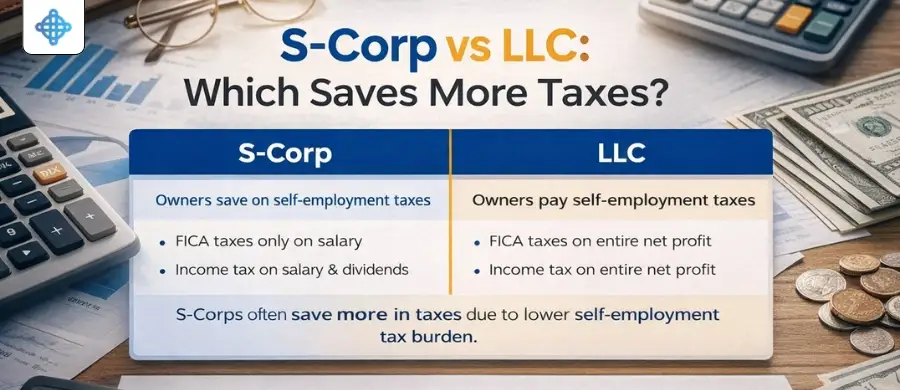
LLC Default Taxation:
All profits subject to:
- Self-employment tax (~15.3%)
S-Corp Taxation:
- Salary portion → payroll taxes apply
- Distribution portion → NOT subject to self-employment tax
This can create significant savings at higher income levels.
WHEN DOES AN S-CORP SAVE MORE TAXES?
S corp tax savings generally occur when:
- Net profit exceeds ~$50,000–$75,000
- Owner does not need to take all profit as salary
- Payroll compliance is properly managed
Example:
If business earns $120,000:
LLC:
- Entire amount subject to self-employment tax
S-Corp:
- $70,000 salary (taxed)
- $50,000 distribution (not subject to self-employment tax)
Savings may be several thousand dollars annually.
WHEN AN LLC MAY BE BETTER
An LLC may be better when:
- Profit is low
- Owner takes all income as salary anyway
- Business is new and revenue is uncertain
- Simplicity is preferred
- No payroll complexity desired
S-Corp compliance costs may outweigh benefits at lower income levels.
COMPLIANCE DIFFERENCES
Businesses in:
- New Jersey
- Pennsylvania
Face different compliance layers.
New Jersey Considerations:
- Progressive state income tax
- Corporate business tax implications
- Multiple payroll programs
- Higher compliance oversight
Pennsylvania Considerations:
- Flat income tax
- Local earned income tax (EIT)
- Corporate net income tax (if applicable)
- Payroll withholding rules
Entity choice affects how these taxes apply.
PAYROLL REQUIREMENTS FOR S-CORPS
S-Corps must:
- Run formal payroll
- File quarterly payroll reports
- Pay employer payroll taxes
- Maintain compliance records
Failure to follow “reasonable salary” rules can trigger IRS scrutiny.
This is why CPA guidance is critical.
COST COMPARISON: LLC VS S-CORP
| Factor | LLC | S-Corp |
|---|---|---|
| Setup complexity | Low | Moderate |
| Payroll required | No | Yes |
| Self-employment tax | On all profit | Only on salary |
| Compliance burden | Lower | Higher |
| Tax savings potential | Limited | High (at scale) |
The “better” option depends on profit level.
BUSINESS GROWTH STRATEGY MATTERS
Choosing entity structure is not only about current tax savings.
Consider:
- Future hiring plans
- Multi-state expansion
- Investor considerations
- Long-term exit strategy
Entity structure impacts long-term scalability.
COMMON MISTAKES BUSINESS OWNERS MAKE
Avoid:
- Electing S-Corp too early
- Ignoring reasonable salary rules
- Mixing personal and business funds
- Not adjusting estimated tax payments
- Forgetting state-specific compliance
Many DIY entity elections result in unexpected penalties.
HOW KP ACCOUNTING HELPS YOU DECIDE
KP Accounting evaluates:
✔ Profit projections
✔ Current income level
✔ Payroll feasibility
✔ NJ & PA tax implications
✔ Long-term growth goals
✔ Compliance risk
Rather than giving generic advice, KP Accounting builds a tailored tax structure strategy.
REALISTIC TAX SAVINGS ANALYSIS
S corp tax savings only apply when:
- Salary is reasonable but not excessive
- Business profit exceeds payroll needs
- Compliance costs are accounted for
Savings are not automatic.
Strategic analysis matters.
ESTIMATED TAX PAYMENTS UNDER EACH STRUCTURE
LLC:
- Quarterly estimated tax payments required
S-Corp:
- Payroll withholding covers part of taxes
- Estimated taxes may still apply
Proper planning prevents underpayment penalties.
AUDIT RISK & IRS SCRUTINY
S-Corps face scrutiny if:
- Salary is unrealistically low
- Distributions are excessive
- Payroll filings are inconsistent
CPA oversight reduces risk.
LONG-TERM TAX PLANNING BENEFITS
When structured correctly:
- S-Corp may reduce self-employment tax
- LLC offers simplicity
- Hybrid planning strategies may apply
Tax efficiency evolves as business grows.
People Also Ask
Does an S-Corp save more taxes than an LLC?
It can, especially when business profit exceeds $50,000–$75,000 and payroll is structured correctly.
What are the main S-Corp tax savings?
Savings come from reducing self-employment tax on distribution income.
Is S-Corp better in NJ or PA?
It depends on income level, payroll compliance ability, and state-specific rules.
Do I need a CPA to switch to S-Corp?
Strongly recommended. Improper elections can create penalties.
Can an LLC elect S-Corp taxation?
Yes, an LLC can choose to be taxed as an S-Corp.
CONCLUSION – WHICH SAVES MORE TAXES?
There is no universal answer.
- Low income → LLC may be best
- Moderate to high profit → S-Corp may save thousands
- Multi-state operations → Structured CPA planning essential
For business owners in New Jersey and Pennsylvania, entity decisions should never be based on internet myths.
They should be based on:
- Real profit analysis
- State compliance rules
- Payroll feasibility
- Long-term growth planning
KP Accounting helps business owners structure their companies strategically to maximize tax savings while staying compliant.
Not Sure If You’re Paying Too Much in Self-Employment Tax?
Choosing the wrong structure could cost you thousands every year. A quick CPA analysis can reveal whether S-Corp tax savings apply to your business.
