Table of Contents
- Cash vs Accrual Accounting: Which One Should Your Business Use?
- Understanding the Two Main Accounting Methods
- What Is Accrual Accounting?
- Cash vs Accrual Accounting: Detailed Comparison
- Cash vs Accrual: Which Method Is Better for Different Types of Businesses?
- Cash vs Accrual Examples
- Pros & Cons of Cash and Accrual Accounting
- Which Accounting Method Should Small Businesses in PA & NJ Use?
- When Should You Switch From Cash to Accrual Accounting?
- IRS Rules You Must Know
- How Accounting Method Affects Taxes in PA & NJ
- Professional Recommendation: How to Choose the Right Method
- FAQs
- CONCLUSION – Choose the Accounting Method That Supports Your Business Goals
Cash vs Accrual Accounting: Which One Should Your Business Use?
Choosing the right accounting method is one of the most important financial decisions a small business will make. Whether you operate in Pennsylvania, New Jersey, or anywhere else in the United States, your accounting method determines how income is reported, how taxes are calculated, and how accurately you understand your financial health.
Although most small business owners know that “cash accounting” and “accrual accounting” exist, far fewer understand the implications of choosing one over the other. And the consequences can be significant, especially when it comes to tax planning, IRS compliance, budgeting, forecasting, and business growth.
This comprehensive guide explains everything you need to know about cash vs accrual accounting, when each method should be used, and how to determine the best accounting method for your business.
Understanding the Two Main Accounting Methods
Before comparing the methods, it’s essential to understand what each one actually means.
What Is Cash Accounting?
Cash accounting is the simplest method and is commonly used by small businesses, sole proprietors, independent contractors, and service-based operations.
Under the cash method:
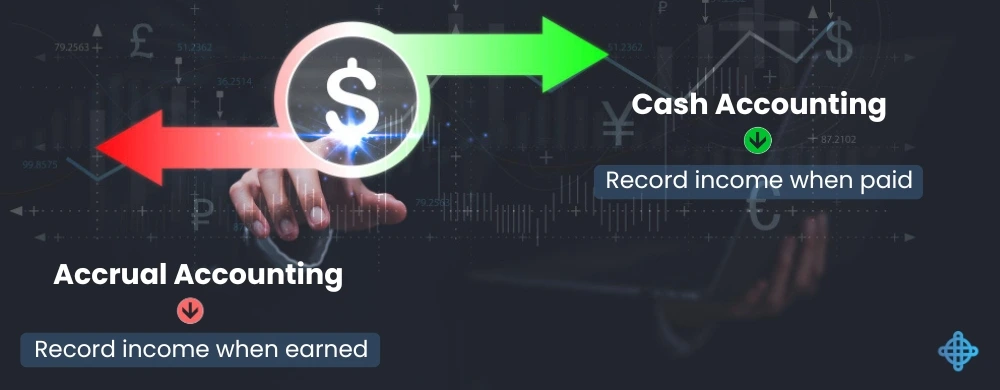
- Income is recorded when cash is received.
- Expenses are recorded when cash is paid.
Example:
A client pays you on February 10 for work completed in January.
Under cash accounting, this income is reported in February, not January.
Advantages of Cash Accounting
- Simple to manage
- Easy to understand
- Provides a clear picture of real cash on hand
- Reduces administrative burden
- Fewer accounting adjustments required
Disadvantages of Cash Accounting
- Does not show true profitability
- Income can be artificially inflated or reduced depending on timing
- No tracking of accounts receivable
- Not accepted for businesses with inventory (in most cases)
- Limited accuracy for financial planning
The cash method works well for very small businesses in PA & NJ with straightforward operations and limited invoicing.
What Is Accrual Accounting?
Accrual accounting is the method used by most established businesses and is required by the IRS for certain industries.
Under the accrual method:
- Income is recorded when earned, even if not yet received.
- Expenses are recorded when incurred, even if not yet paid.
Example:
You invoice a client on January 25 for work completed that month.
The client pays you on February 10.
Under accrual accounting, this income is reported in January, not February.
Advantages of Accrual Accounting
- Provides a more accurate picture of profitability
- Tracks accounts receivable and accounts payable
- Better for budgeting and forecasting
- Reflects true financial performance
- Required for larger businesses or those with inventory
Disadvantages of Accrual Accounting
- Requires more bookkeeping
- More complex for beginners
- May show profit even when cash is low
- Requires adjusting entries
Accrual accounting is the better method for growing businesses, multi-location companies, and any business in PA or NJ that manages inventory or billing cycles.
Cash vs Accrual Accounting: Detailed Comparison
1. Cash vs Accrual Accounting: Detailed Comparison
Below is a comprehensive, CPA-level comparison of both methods.
| Category | Cash Method | Accrual Method |
|---|---|---|
| Revenue Recognition | When cash is received | When earned (invoice date) |
| Expense Recognition | When cash is paid | When expense is incurred |
| Financial Accuracy | Basic | High |
| Best For | Sole proprietors, freelancers | Growing businesses, inventory-based businesses |
2. Financial Visibility
Cash Method:
Shows how much cash you have available.
Good for understanding short-term liquidity.
Accrual Method:
Shows whether the business is actually profitable.
Provides long-term financial visibility.
If you want to understand your true business performance, accrual accounting is superior.
3. Tax Impact
Cash Method Tax Benefits
- Taxable income only includes money actually received
- You can delay revenue by waiting to invoice
- No tax on unpaid invoices
Accrual Method Tax Benefits
- Matches income with related expenses
- More accurate reflection of profit
- Better for tax planning with predictable revenue cycles
However, accrual may require paying taxes on income you haven’t collected yet.
4. Compliance Requirements
The IRS requires accrual accounting for:
- Businesses with average annual revenue exceeding $30 million
- Businesses that maintain inventory (exceptions apply)
- C-Corporations
- Tax shelters
- Certain farming and manufacturing operations
In Pennsylvania and New Jersey, state tax reporting largely follows federal rules, meaning:
- If the IRS requires accrual, PA and NJ will require accrual as well.
- Service-based businesses in PA/NJ may continue using cash accounting unless growth or inventory rules apply.
Cash vs Accrual: Which Method Is Better for Different Types of Businesses?
Below is a CPA-level breakdown of industries and which method typically suits them.
Cash Accounting Works Best For:
✔ Sole proprietors
✔ Freelancers and consultants
✔ Independent contractors
✔ New businesses with simple transactions
✔ Service-based businesses with no inventory
✔ Businesses needing a simplified bookkeeping process
Cash accounting is especially popular among:
- Tutors
- Cleaning services
- Landscaping companies
- Real estate agents
- Photographers
- Therapists and wellness providers
- Local service providers in PA & NJ
Accrual Accounting Works Best For:
✔ Businesses with inventory
✔ E-commerce stores
✔ Construction companies
✔ Manufacturing businesses
✔ Medical and dental practices
✔ Marketing agencies
✔ Businesses applying for loans
✔ Any growing company planning expansion
Accrual accounting gives PA and NJ business owners a more accurate picture of their long-term financial health.
Cash vs Accrual Examples
Understanding the difference through real examples makes it clearer.
Scenario 1: A Retail Store in New Jersey
January Sales: $30,000
Customer Payments Collected: $18,000
Unpaid Invoices: $12,000
Cash Accounting Result:
Revenue reported = $18,000
Accrual Accounting Result:
Revenue reported = $30,000
Accrual shows the real revenue earned, even if unpaid.
Scenario 2: A Contractor in Pennsylvania
January Expenses:
- Purchased materials on credit: $5,000
- Paid wages: $3,000
Cash Accounting Result:
Expenses reported = $3,000 (since materials are unpaid)
Accrual Accounting Result:
Expenses reported = $8,000 (materials + wages)
The accrual method shows the full cost of operations for the month.
Scenario 3: A Marketing Agency in Allentown, PA
Invoices Sent: $10,000
Payments Received: $4,000
Cash Accounting Profit: $4,000
Accrual Accounting Profit: $10,000
Accrual shows revenue you earned, not just received.
Cons of Cash and Accrual Accounting
Below is a detailed breakdown.
Advantages of Cash Accounting
- Easy to manage
- IRS-approved for most small businesses
- Better for cash management
- Reduces bookkeeping workload
- Useful for businesses with irregular cash flow
Disadvantages of Cash Accounting
- Less accurate financial statements
- No accounts receivable tracking
- No accounts payable tracking
- Harder to analyze profit trends
- Not allowed for inventory-heavy businesses
Advantages of Accrual Accounting
- Clear financial picture
- Better decision-making
- Tracks receivables and payables
- Required for larger companies
- Stronger for long-term planning
Disadvantages of Accrual Accounting
- More complex
- More bookkeeping work
- Requires adjusting entries
- May show profit even during cash shortages
Which Accounting Method Should Small Businesses in PA & NJ Use?
Different states have different business environments, especially regarding taxes, compliance, and industry structure.
For Businesses in Pennsylvania
Accrual accounting is recommended for:
- Construction & trade contractors
- Manufacturing businesses
- E-commerce stores (Philadelphia & Pittsburgh markets)
- Medical practices
- Home-service businesses with invoicing systems
Cash accounting is suitable for:
- Solo service providers
- Freelancers
- Appointment-based businesses
- Micro-businesses
For Businesses in New Jersey
Accrual accounting is recommended for:
- Retail stores
- Logistics and transportation businesses
- Restaurants and food services
- Mid-sized service companies
- Growing businesses seeking loans
Cash accounting is suitable for:
- New start-ups
- Low-volume service providers
- Home-based businesses
When Should You Switch From Cash to Accrual Accounting?
You should strongly consider switching when:
✔ Annual revenue approaches or exceeds $30 million
✔ You begin carrying inventory
✔ You plan to apply for a bank loan
✔ You start invoicing customers with 30+ day terms
✔ You want accurate profit reports
✔ You plan to sell or scale your business
✔ You hire employees or contractors
Migrating from cash to accrual requires adjusting entries and proper bookkeeping alignment. A CPA should always guide the transition.

IRS Rules You Must Know
The IRS provides clear guidelines:
Cash Method Allowed If:
- Revenue is under $30M
- No inventory
- Not a C-Corporation
- Not a tax shelter
Accrual Method Required If:
- Inventory is part of your business
- You exceed revenue thresholds
- You are a C-Corp or partnership with a C-Corp partner
Pennsylvania and New Jersey generally follow federal rules, but a CPA can advise on state-level adjustments.
How Accounting Method Affects Taxes in PA & NJ
Cash Method Tax Insights
- Income is taxed only when received
- Can defer tax by delaying invoicing
- Improves short-term tax planning
Accrual Method Tax Insights
- Income taxed when earned (even if unpaid)
- Aligns with GAAP standards
- Better for accurate deductions
State tax implications also depend on industry type and filing status.
Professional Recommendation: How to Choose the Right Method
When advising small businesses in Pennsylvania and New Jersey, CPAs generally consider:
✔ Business size
✔ Revenue consistency
✔ Industry type
✔ Inventory requirements
✔ Long-term goals
✔ Loan requirements
✔ Tax forecasting needs
If your priority is simplicity → Cash Method
If your priority is accurate financial reporting → Accrual Method
FAQs
What is the difference between cash and accrual accounting?
Which accounting method is better for small businesses?
Do businesses in Pennsylvania and New Jersey need to use accrual accounting?
Can a business switch from cash to accrual accounting?
CONCLUSION – Choose the Accounting Method That Supports Your Business Goals
The choice between cash and accrual accounting is not simply an administrative decision – it is a strategic financial decision that influences every part of your business operations.
For small businesses in Pennsylvania and New Jersey, cash accounting offers simplicity and ease, while accrual accounting provides greater accuracy and deeper financial insight.
The right method depends on your business size, growth goals, industry, and tax requirements. A CPA guided evaluation ensures your accounting method supports your business today and positions you for growth tomorrow.
Contact KP Accounting to evaluate the best accounting method for your business and build a strong, scalable financial foundation with confidence.